Showing posts with label Claude Monet. Show all posts

Tuesday, January 21, 2025

Animated Thoughts: A surprising find in a surprising place

This past weekend, I flew to New Orleans for my brother-in-law's 60th birthday party--what we all were calling "John Con 2025" by the end of the weekend. Hadn't seen that side of the family for a while and John is a great guy, so when I got the invite, there really was no decision to make, just a little shuffling of cash from one account to another to pay for the plane ticket and hotel.

My sister, ever the planner, had a series of "group" events set up for everyone to celebrate John's birthday but there was also some free time available where we could wander New Orleans by ourselves and do a little exploring.

Fresh beignets

Well, true to form, she selected our first meetup at the Café du Monde on the north side of town. Not the one by the waterfront where I had been before, no, this was the one a five minute walk from the New Orleans Museum of Art. So after getting sugared up on beignets, it was time to get moving and walk off some of that breakfast. The pre-planned walking tour of the French Quarter wouldn't be until the early afternoon, so I had time to walk across the street to the New Orleans Museum of Art.


The first surprise was seeing a Claude Monet painting that I've never seen in person before. 'Houses' is a bit of a departure from the flowing pastels that I'm used to. But it's a welcome one as it still displays Monet's signature brushstrokes and stylization.

Houses on the Old Bridge at Vernon, c. 1883

Another exhibit I really enjoyed was their special exhibit on the history of glasswork. There were multiple examples of ceramics and glasswork all around the museum, but this exhibit was a more expansive history of glasswork from around the world with examples spanning a wide range of techniques and styles. If you're in the area, it's worth checking out. As I took the photos, my mind was going a mile-a-minute figuring out how I'd model them in 3d CGI.

"Tumble-up" cup and decanter, c.1860

Decanter, c.1880 - Uranium glass

Necklace with 19 minature Easter Eggs from
the workshop of Carl Fabergé

But the surprise of the visit was seeing a painting by artist Wayne Thiebaud.

Salmon Rose, 1966

On the placard, it stated "Disney animator", though my cursory research only revealed that he was an inbetweener for Disney during one summer before going on to producing commercial art, achieving a Masters degree in art history, and teaching at the University of California, Davis (among other accomplishments). [1]

Although I'm clearly biased here given the subject, I still think that it's the mark of a really good display that causes you to want to learn more about the artist, the art style or movement, or what influenced the artist when they were creating said artwork. Yes, I admit it, I'm one of those weirdos that you see in the museum, sitting down and looking at their smartphones while surrounded by priceless works of art. Well, more often than not, it's because I've seen something that sparks an interest and I want to know more about the artist or the times that they lived in. So rather than look it up later, I prefer to do my research immediately. If I take a couple pictures and promise myself that I'll do some research when I get home, well, more often than not life does tend to get in the way so better to capitalize on the moment.

So, I'd like to give props to the NOMA and their curators for putting together a very interesting collection of artwork. I wish that I would have had more time to enjoy their museum and sculpture park, but NOMA is now on my list of museums that deserve a return visit when I'm back in the area.

* * *

[1] https://web.archive.org/web/20110428144554/http://www.smithsonianmag.com/arts-culture/Wayne-Thiebaud-is-Not-a-Pop-Artist.html

Sunday, January 5, 2025

Animated Thoughts: Art Comes in Many Forms, pt. 6 - the "end of year" edition

I had hoped to end the old year and begin the new with some art and peaceful introspection. The Flint Institute of Arts did not disappoint.

Now I'll cop to it, looking at the main art museums in the Mid-Michigan corridor (Grand Rapids/East Lansing/Flint/Detroit), I vastly favor the Detroit Institute of Arts. But the smaller art museums here in Michigan have their charms. The Frederik Meijer Gardens has their yearly butterfly and orchid events as well as a wonderful outdoor Japanese garden. I haven't yet been to the Grand Rapids Art Museum, though I do hope to change that oversight later this year. The Broad Art Museum is a quick five minute drive from my home with a basement area housing older works of art and a video installation--and it's a quick walk from the MSU Library, good for research. Detroit has the DIA as well as the Henry Ford Museum and Greenfield Village--all three had been invaluable resources when I was writing my animation history class. 

But the Flint Institute of Arts has some really appealing qualities, not the least of which is a 45 minute drive from my home (as opposed to the hour/hour-and-a-half to the DIA, depending on traffic). They've also got a well-stocked library with comfortable chairs and a sofa for reading.
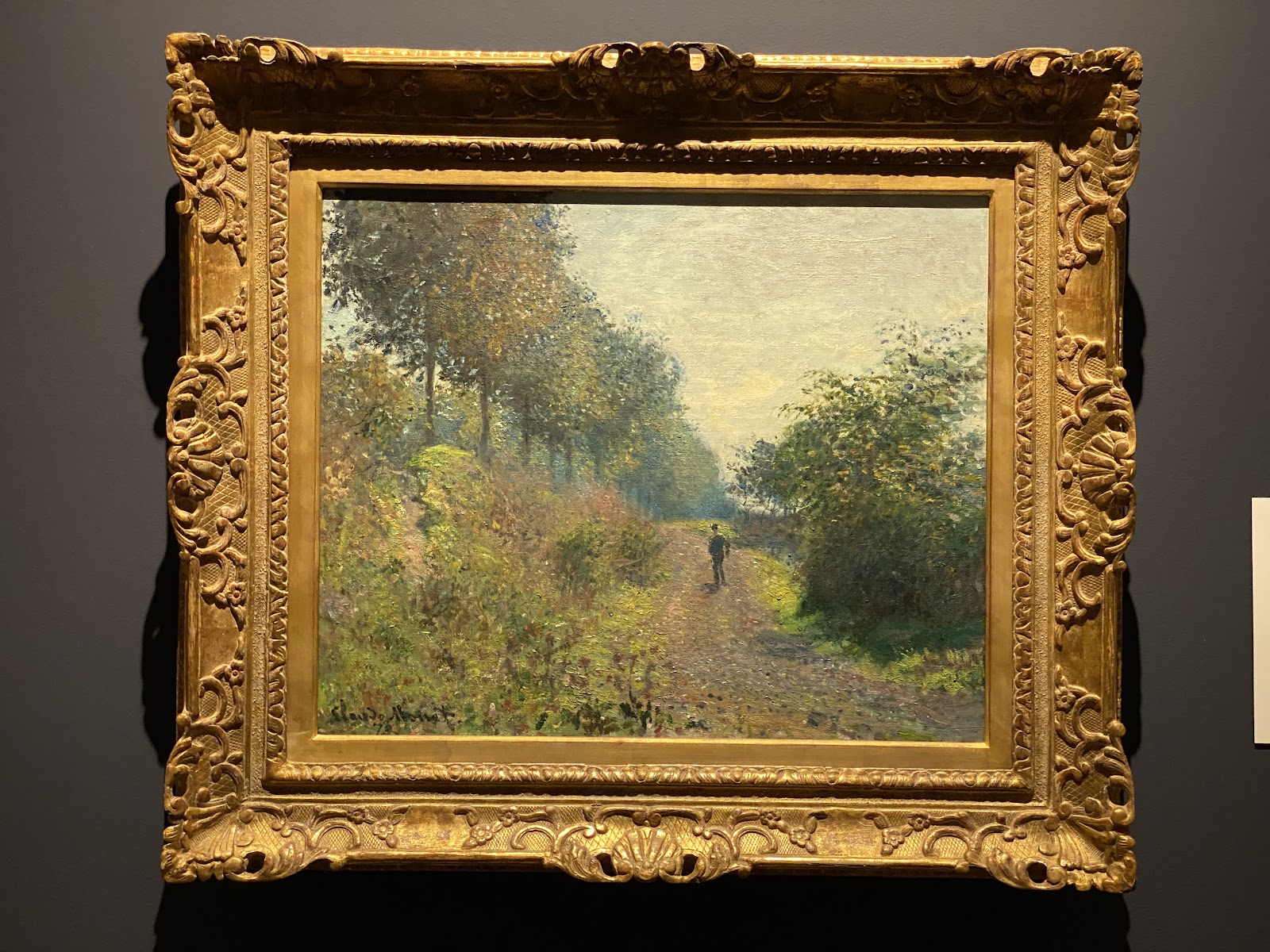
"The Sheltered Path", 1873
Claude Monet

The decision of where I would spend my day was resolved almost immediately when I checked the FIA's website and discovered that they had a painting on display by my favorite artist: Claude Monet. Turns out, "The Sheltered Path" was on their visiting artwork list and would be on display until February.

As I stared at Monet's painting, I was struck by the impermanence of digital. There I sat, looking at a painting from 1873. The colors may not be as vibrant as when it was first painted, but still a beautiful work of art that, if properly handled, would still be there long after I am but a memory.

Over the past thirty years, I've witnessed countless works of art brought to life through computer software. I've been there during software releases and upgrades, and yes, witnessed software once touted as the 'latest and greatest' denoted as reaching their 'end-of-life' before being relegated to the dustbin of digital history. 

3d CGI, polygonal modelling, NURBS, metaballs, texture mapping, bump mapping, non-linear video editing, Corel Draw, Paint Shop Pro, Photoshop, Painter, Kai's Power Tools, Director, After Effects, Future Splash/Flash, Moho, Bernoulli drives, iOmega Zip Drives. I was there for much it. Oftentimes on the sidelines, sometimes in the trenches.

The march of technology is relentless. It's partially why I maintain a number of old computers with obsolete operating systems that are still capable of running some of this older software--so I can still access old copies of animations and imagery that I produced during my college and grad school days.

The computer has brought us works of art that were hitherto undreamt of. I doubt that even the old masters could have conceived of what is being produced by contemporary digital artists. I have to wonder, how constrained were their imaginations by the technology of their time? Thought for another day.

Back when I was in grad school at R.I.T., I had been playing with a freeware 3d rendering and animation software package called POV-Ray. It was a text based system where you'd plot everything out on graph paper using the Mark I pencil, then create a text file containing all the objects, their coordinates, and their properties for your scene. I was big on stone textures back then, so spent a fair amount of time making marbles using the various texture settings. This would serve me well when I needed objects to animate in my basic animation classes--like learning the squash and stretch principle by animating bouncing balls using Macromedia Director.
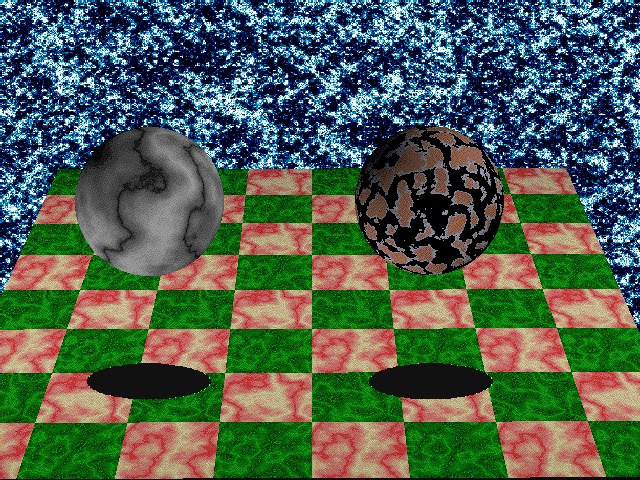
Squash and Stretch assignment

Since then, I have tinkered with lots of 3d modelling and animation packages like Alias Wavefront/Maya, Ray Dream Studio/Carrara, and Blender. But while useful and entertaining, none of those programs produce anything of permanence. I do still like to walk through museums and look at sculptures--mostly those of stone and glass--and think about how I would recreate them using 3d CGI software. It's a fun thought exercise and it adds an extra dimension to museum visits that makes them more enjoyable for me.
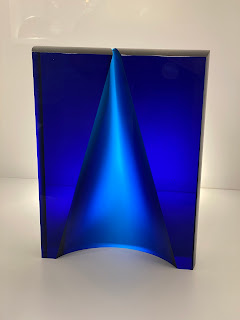
"Hadros", 2006
Petr Hora

Sculpture, paintings, celluloid film, animation cels, photographs from the early 1900's, even the hand-drawn paper cels from my MFA thesis, they will all outlive me. My thesis film is digital. Unless I do a transfer to celluloid film stock, one day, it will likely be gone with only the hand drawn cels and a couple printed images in my thesis paper as evidence that it ever existed. If care has been taken to preserve them, one hundred years later, we can still watch films from the 1920's. One-hundred and fifty-two years later, I can still spend an afternoon looking at one of Claude Monet's paintings hanging there on the wall. Over five hundred years later, we can still travel to Florence and appreciate Michelangelo's marble sculpture "David".
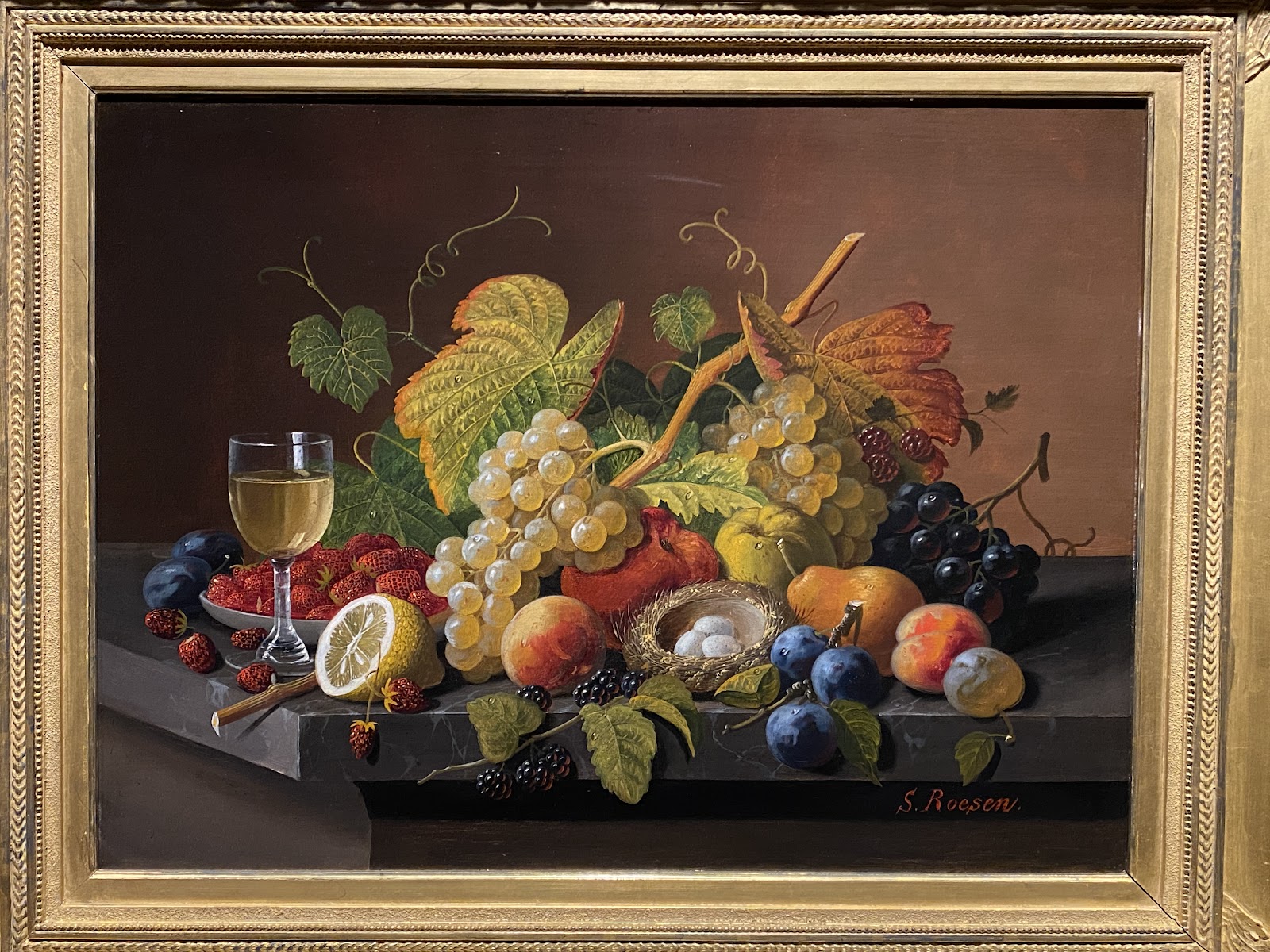
"Still Life with Fruit", 1855
Severin Roesen

I have to wonder, five-hundred years from now, will people even know about all the art we created in the late 20th/early 21st Century? Or will there be this huge cultural gap where art was being produced in physical format up until the 1980's and then it largely ceased. What will the museums of 2525 say about us? Will they even remember that we existed or will we just be a footnote in history, this big black hole of nothing called 'the digital age' where very few items of cultural significance survived to be appreciated by future generations?

* * *

Thursday, November 30, 2017

Animated Events: Framing Monet

So for you folks who are into the French Impressionists like I am, the Detroit Institute of Arts currently has an exhibit highlighting a series of Claude Monet's paintings which were created during a short period of time (around the early- to mid-1870's) at his home in Argenteuil  and accented by paintings by Pierre-August Renoir completed around the same time-frame.


Titled Monet Framing Life, this exhibit opened on the weekend of October 22nd, 2017. Tickets for adult admission cost $16, but is free for we members of the DIA (enter shameless plug for DIA membership here).

'Framing Life' has as it's centerpiece the DIA's own Monet painting "Gladioli"--which served as the figurative focal point for the paintings in the exhibit. All the paintings are centered around the time period that Gladioli was painted and highlight the scenes that Monet would have seen in Argenteuil during the few short years surrounding the creation of Gladioli.

The following are just some samples of the paintings included in the exhibit. And while I could show them all (non-flash photography "is" allowed in the exhibit), I really don't want to detract from the experience of seeing these paintings in person--partially because if the DIA makes money on shows like this, it will encourage them to bring in more, and partially because you just can't truly appreciate these paintings through a photograph on a website. You really need to see them in person. They're not behind glass (though the security guards are very vigilant at preventing people from getting close enough to set off the alarms or damage the paintings with an errant sneeze), the lighting is very suitable for viewing the paintings, and there's just something special about being able to study a masterwork from different viewing angles. All three times I've gone through the exhibit, I've picked up something different each time ranging from the angle of the brushstrokes to the choice of colors used to show the range of light and shadow to the different expressions on his subjects' faces.

Argenteuil
Claude Monet, ~1872


Snow in Argenteuil
Claude Monet, 1875


The Artist's Garden in Argenteuil
Claude Monet, 1873

Claude Monet Painting in His Garden at Argenteuil
Pierre-Auguste Renoir, 1873

I was very fortunate to attend a lecture during the exhibit's opening weekend presented by Jill Shaw, Associate Curator of European art (1850-1950) and the curator of this exhibit. Jill not only covered historical information about the paintings and Claude Monet during this period of his life, but she also delved into the forensic work and research into the history of the only Monet painting that the DIA owns (Gladioli)--research which prompted the DIA to change the name of "Gladioli" back to "Rounded Flower Bed (Corbeille de fleurs)".

Rounded Flower Bed (Corbeille de fleurs), formerly "Gladioli"
Claude Monet, 1876
The last thing I'll share is the exhibit catalog. Written by Jill Shaw, the information contained therein covers much of what she discussed in her presentation during the members preview weekend lecture I attended.

It's only $20 and not only does it contain beautiful photos of the paintings but it also puts the paintings in their historical and geographical context before launching into a section discussing the history of 'Corbeille de fleurs'. It was this section that I found most interesting, especially in the greater context of the exhibit. The final painting in the exhibit is the newly (re)christened 'Rounded Flower Bed'. However, as opposed to being wall mounted like the other paintings, Rounded Flower Bed is mounted vertically in a glass box that allows one to see both the front and the back of the painting--including stamps and handwriting which were used to backtrack the history of the painting.

Monet - Framing Life
by Jill Shaw, Associate Curator of European art (1850-1950)

Upon my third visit to the exhibit, I did something a little different. Since 'Monet - Framing Life' is small, lightweight, and only sixty-four pages long, I took it with me into the exhibit and walked from painting to painting while reading the first half of the book. Doing so added an additional dimension to my enjoyment of the exhibit as I wasn't relying solely on the placards or on my memory of Jill's lecture to provide context for the paintings.

Given that I'm more of an auditory learner, if one was offered, I would have loved to take an audiobook through the exhibit so I wouldn't have to split my focus between the painting and the text. The Art Gallery of Ontario currently has a display on the horror films of Guillermo del Toro and he produced a series of short podcasts that you can download and listen on your smartphone while going through the exhibit. It's these value-add propositions that I think really breathes new life into museums as well as expands their educational offerings. They have been using audio guides for decades after all. That and the DIA is already experimenting with augmented reality on smartphones. Ah, Google Glass, you missed your calling. 'Augmented Reality museums'. It could have been the wave of the future!

Well, this exhibit is available to the public right now but will close on March 4, 2018 and the paintings will return to their respective owners, so I would visit the DIA to see this exhibit sooner rather than later.

The Detroit Institute of Arts is located at: 5200 Woodward Ave., Detroit, MI 48202 and tickets for this exhibit can be purchased either onsite or on their website.

Monday, October 16, 2017

Animated Events: DIA 'Monet: Framing Life'

Gladioli, c.1876, Detroit Institute of Arts
For those of you that are of a mind, the Detroit Institute of Arts will be hosting an exhibit on Impressionist artist Claude Monet (with works supplemented by Pierre Auguste Renoir).

This exhibit will be hosted from October 22, 2017 until March 4, 2018.

More information can be found on the DIA's website including tickets and exhibition events at the following link.