Happy International Animation Day!!
Showing posts with label ASIFA Central. Show all posts
Showing posts with label ASIFA Central. Show all posts
Monday, October 28, 2024
Monday, October 21, 2024
Animated Events: International Animation Day 2024
It's that time of year:
time for ASIFA's International Animation Day!
time for ASIFA's International Animation Day!

ANIMATION SCREENING
SATURDAY & SUNDAY
OCTOBER 25 & 26
Free admission!!
Burgers and Boba
526 E. Main Street
Edmore, Michigan 48829
2:00 p.m. – 4:00 p.m.
* * *

Thursday, October 28, 2021
International Animation Day 2021

Happy International Animation Day--the day where ASIFA chapters all over the world celebrate the birth of animated film! The image above is the 2021 IAD Poster created by Maryam Mohajer.
Tuesday, July 21, 2020
Animated Events: ASIFA Central 2020 Animators Retreat

 |
| All of us feverishly taking notes on James' talk. |
The next day, there was kind of a downer with one of my events. I was in charge of running the "Saturday Morning Cartoons" block, where we all got together with our favorite bowl of sugary cereal (or granola) and watched a playlist of vintage and current animated shorts that I put together on YouTube. Well, wouldn't you know it, halfway into the second cartoon, YouTube shut the stream down for technical reasons so we all had to log into YouTube on our browsers and start up the show individually. A bit disappointing as it meant that we couldn't all watch together as a group--like an Amazon watch party, but regardless, everyone seemed to enjoy the films that I had curated.
 |
| Zoom Pixilation |
Next, we did our yearly microtalks followed by afternoon workshops. I attended Julie's 3d world-building using Maya workshop. But a number of the other attendees worked on a cut-out animation group project, others created a pixilation animation using Zoom.
 |
| Seder Masochism |
On Sunday, we held our members meeting where we all met up in a Zoom conference room and discussed the ASIFA Central charter, what it is/is not, what it states regarding personnel positions and election procedures, and all of the proposed changes that were made based upon prior discussions. All told, I thought it was a very productive meeting--and I'm not just saying that because I was the person who was running the meeting. As I'm one of those people who believes in transparency within an organization, I think that it's always good for our members to know how the organization is run, who is doing what, and how funds are being spent.
One of the highlights of our yearly retreat is when Jim Middleton does a
talk explaining current public domain law, changes to public domain,
and lists out some of the films and music that has entered the public
domain. Jim did a five minute microtalk on Saturday talking about public domain resources for music then expanded upon it during his Sunday lecture.
On Sunday, our final guest, Chris Sullivan, discussed his current feature film project 'Orbits of Minor Satellites' and showed us clips of his progress.
It was hard to capture the energy of an in-person ASIFA Central retreat, not going to lie. But it was fantastic to have so many people showing up from all around the world and it brought it's own energy to the event.
Can't wait until next July.
* * *
*Photos from the ASIFA Newsletter, used with permission.
Tuesday, August 6, 2019
Animated Thoughts: ASIFA Central 2019 Retreat
 |
| Meet me in St. Louis... |
This year, the ASIFA Central retreat was held in St. Louis and graciously hosted by Webster University, home of our Social Media Coordinator: Chris Sagovac. After a joyful seven-and-a-half hour drive filled with discussions about animation and gaming with fellow ASIFA Central members Brad Yarhouse and Robert Sweringa, we arrived in St. Louis for a fun-filled weekend of animation -- starting with a meet-and-greet over dinner at Blueberry Hill between our members and Chris's colleagues and students from Webster.
 |
| Keynote address delivered by ASIFA Central President Brad Yarhouse |
A lot of the animation workshops we played with during the retreat followed the theme of non-traditional animation techniques: direct-on-film, digital direct-on-film, and pixilation.

At one station, Chris had set up markers and ink with strips of clear 16-mm film where we could experiment with direct-on-film techniques.

Additionally, in one of the computer labs, Steve Leeper demonstrated his Photoshop scripts designed to produce digital direct-on-film animation. Fortunately for me, I remembered my Adobe Creative Cloud username and password so Deanna and I were able to share a workstation and produce some short films using Steve's technique. I begrudgingly pay my monthly "rent" to Adobe for the Creative Cloud but I have to admit that it did pay off this time.

When finished, Steve compiled all of our films together for viewing later that afternoon. My section of the digital direct-on-film animation is below:
In the other room, a group of members and students were producing an animated film using the pixilation technique. Former honorary ASIFA President Norman McLaren would be proud to know that there are kids still using the animation technique that he used to create his award winning film Neighbors.

After a delightful lunch generously provided by Webster University, we devoured the yearly ASIFA Central cake, which miraculously survived the trip, and settled in for an afternoon of screening our films, Brad's update on International Animation Day, Deanna's update on ASIFA International, and a series of microtalks which included my in-memorium presentation of experimental animator Suzan Pitt and a very informative student presentation on Astro Boy.

The next day, we packed up our cars to go home, but beforehand, we all met up for breakfast at the Highway 61 Roadhouse, another St. Louis landmark, for brunch and a little more community before making the hours long trek home.
 |
| (Image courtesy of ASIFA Central) |
* * *
Tuesday, September 18, 2018
Animated Thoughts: ASIFA Central Retreat and Lotte Reiniger
 |
| Silhouette illustration for I want you Illustration by Lotte Reiniger |
As seen in my last post, we held our annual ASIFA Central members retreat in August. Not wanting to miss an opportunity to work on my public speaking skills, I volunteered to give a short presentation on Lotte Reiniger. But rather than offering the same lecture that I had for Women's History Month, I decided to revisit and recycle a portion of that work while adding new information that I don't see any other researchers focusing on.
Much has been said about Lotte's animation work. However, rarely meriting more than a mention or a footnote in books and articles written about Lotte is that around 1918 to 1919 she created 'silhouette' illustrations for a book of German poetry written by Gustav Hochstetter titled Venus in Seide: Ein neues Liebesbrevier (Venus in Silk: A Breviary on New Love), published in 1919.
Hochstetter himself, was an author, poet, humorist, and professor of Jewish-German origin. During his lifetime, he wrote over twenty books, of which, Venus in Silk was one. Tragically, Gustav Hochstetter would be swept up by the Nazi's in World War II. He was deported from Berlin to the Radinkendorf labor camp in Poland and then, on October 3rd, 1942, sent to the Thereisenstadt ghetto in German-occupied Czechosloakia. Gustav Hochstetter would die a year-and-a-half later at the age of 70.
 |
| Venus in Seide (Venus in Silk) by Gustav Hochstetter |
After coming across his name (and the title Venus in Seide) while reading Whitney Grace's book Lotte Reiniger: Pioneer of Film Animation, I did a little digging into the history of Hochstetter. Confident that he was a part of Lotte's history that needed to be told, I then tracked down a first-edition copy of Venus in Seide at a bookseller in Germany -- Chiemgauer Internet Antiquariat, owned by Frauke Strassberger. About a week later, a weathered, well read book arrived in the mail.
Then came the difficult part.
Researching Hochstetter wasn't too bad. There's enough information about him on the internet to pull together a couple slides about his life. The tough part was translating portions of Venus in Seide! However, between my next-to-useless two years of college German and my fluency in Google Translate, I was able to cobble together several complete poems in addition to captions for Lotte's illustrations.
My initial plan was to show Lotte's silhouette illustrations in my slides and perform an analysis of her static models for print compared to her dynamic models designed for animation, but I quickly became swept up in the excitement of translating Gustav's poems. What first was an attempt to put Lotte's illustrations into their proper context rapidly became a welcome obsession as I tried to get into Lotte's mind, imagining what this young woman must have been thinking when translating the printed word into an illustration designed to accentuate the poem yet showcase it's own sense of beauty without detracting from the richness of the printed word upon which it was based.
The following is one of my favorite poems (from the few that I've translated thus far). You can see Lotte's silhouette illustration on the right side; I recommend looking back at it from time to time as you read Hochstetter's poem. I'm sure you will notice, as I did, how well Lotte's illustration accentuates and reflects Gustav's words and that Gustav's words (in turn) accentuate Lotte's illustration -- especially since Gustav's poem speaks of features that you cannot observe in a black-and-white silhouette.
 |
| Eine muß die Schönste Sein (One must be the most beautiful) Poem by Gustav Hochstetter, illustration by Lotte Reiniger |
One must be the most beautiful (1)
One must be the most beautiful
On the far earth:
Narrow foot, slender leg,
Most charming gesture;
Eyes should be sensuous
Sparkling like diamonds,
Bodice, shoes, hat and dress
A glove resting.
Teeth dazzling; Tied up fine
As in racehorses -
One must be the most beautiful
On the far earth
One must be the singer
This beautiful beauty,
Your charms a magic spell
sounds sing out,
That through his portrait of the world
Watches this golden wonder
He that holds his mirror
You, the most beautiful woman,
That, the song the melody
To indulge in her grace -
One must be the singer
This beautiful beauty.
Now, if you go back and take a close look at the poem in the image above, you can see one of the main difficulties in translation. The font used was this flowing, artistic typeface that obscured some letters, like the 'tsch' or 'sch' consonants. Additionally, the 'S' had at least two separate and distinct forms depending on whether they were capitalized or in lower-case. A magnifying glass was a most helpful tool as I deciphered the individual characters, typed them into Word (making liberal use of their German symbol library), then copied the poem into Google Translate and waited for the English result.
Google Translate itself is an odd bird. After using it to translate portions of several poems, I quickly learned that the algorithms appear to translate many of the words based in part on the context of the sentence -- which can be both helpful at times and very frustrating in others. More than once, I broke down a sentence into it's component words and looked through various definitions in order to translate the sentence into something that was both coherent in English AND maintained the spirit of the poem in its overall context. For someone who loves working on puzzles, I often found myself wishing for more time to translate just "one more poem" before the presentation (and also for a friend who could check my German to English translations).
When paging through this old text, it was very apparent that even at this young age, Lotte Reiniger had developed a skilled eye in creating very clear, very 'readable' poses for her characters as well as the ability to maintain proper proportions for her characters when cutting them from paper. One can only imagine the delight Hochstetter must have felt when Lotte agreed to create the illustrations for his book.
On the day this blog post goes live, coincidentally on Yom Kippur, it has been ninety-nine years since Hochstetter first published his book. I can't even fathom what must have been going through his mind as he lay on his deathbed, having been betrayed by his country and watched friends, family, and countrymen imprisoned and killed. But I think, I hope, that he would be pleased to know that there are people who are still reading his books and enjoying his poetry a century later.
* * *
(1) translation by Charles Wilson
Friday, August 31, 2018
A Year of Animation: ASIFA Central 2018 Retreat
 |
| Gary Schwartz and Linnea Glas |
Every year at the retreat we all spend half the day working on animations. Sometimes it's workshops where we learn a new animation technique or share information, tips, and tricks on a technique we all know. However, this year, the workshop organizers broke us into teams and had each team working to produce an animation based on the same concept. So, each group started at the same point, but was allowed to interpret the project however they wished.
My team consisted of myself, Gary Schwartz of Single Frame Films, and Linnea Glas - a former student of mine from Huntington University - and the project centered on making an animation based on our visual interpretation of the following tongue-twister:
"On the moon, marooned baboons consume balloons to make cartoons."
Each group produced a distinct animation using their own visual choices and own audio recording of the tongue twister. Some used clay, others sand, still others found images. However, the three of us chose to do a "Gary Schwartz" cut-out animation. Y'see, during the year, Gary travels throughout the world and hosts animation workshops. One of his animation projects is using these stylized mouths to animate a line of dialog. So, we appointed Gary as our director and character designer, Linnea as our voice actress, model maker and animator, and I handled the technical side of the animation including camerawork and producing the X-Sheet.
 |
| Linnea working on the models |
This was one of those great learning experiences as it allowed me to explore a facet of Dragonframe that I had only read about and tinkered with on a superficial level: incorporating dialog. While Gary and Linnea designed and created the cut-out mouth syllable models for our animation, I set to work processing the audio -- which consisted of loading it into an audio channel, identifying the syllables, and then making a mock-up animation using a stock figure that comes with Dragonframe.
 |
| Dr. Sock. Great concept, but they left out some syllables when making this model so we had to improvise... |
This was the result of my working with the "Dr. Sock" model, the sock-puppet monkey that comes stock with DragonFrame.
Once the audio was processed and the audio "animatic" completed, I created an X-Sheet that would allow us to select the correct mouth position models and line them up with the dialog. Afterwards, once Gary and Linnea had finished the models, I worked with Linnea (with Gary directing us) as she followed my X-Sheet and animated the mouth models.
 |
| Note the "syllable" column that lines up with specific points in our audio track. |
With a little under an hour left to produce our film, we quickly worked our way through filming the animation as Gary added input to improve the flow and visual variety of the animation (we were using a limited number of syllable models after all). And after the film was finished, Gary had the idea of adding one last set of frames with some soviet-era "dental models" that he picked up on his travels through Eastern Europe, followed by a quick fade-to-black. We all agreed that it added a really nice sense of surrealism to our animation.
Our completed film is as follows:
Wednesday, June 27, 2018
A Year of Animation: ASIFA International Animation Day 2018
Well, since last month I (re)created four animations from grad school for June's "Year of Animation", this month I took it a little easy and participated in an Ani-Jam.
ASIFA Central's intrepid President, Brad Yarhouse, is in charge of ASIFA's International Animation Day, so he proposed that members of ASIFA Central participate in an Ani-Jam centered around the IAD poster. Everyone was given two images from the final poster and instructed to create a transition from the first image to the second. So, your first image will be someone else's second image and your second image is someone else's first, and so on. When completed, the animation will transition from one image to the other in a continuous loop.
In my case, I'm animating a transition from the first image in the poster to the second image.
However, given how much time my grad school archival project is taking, I decided to do a simple morph for my two frames. Transitioning from a character with two eyes to a character with one eye was a bit of a challenge and in the end, I chose to set my control points so that they were focused on specific facial characteristics so that the morph would flow much more smoothly: like the outer ends of the two pupils on one character linked together so they'd match up with the one pupil on the other character. Or the bead of sweat morphing into the glare of light on the Cyclops' eye.
What I am most proud of, though, is how well the noses morphed from one to another. That coupled with the above really draws the focus away from the flaws in the overall animation (like the fade-in of the Cyclops' large green-colored iris). I originally wanted to do this animation freehand on animation bond, but the time and effort required for this project was a little more than I was willing to commit.
You can see the completed animation this Fall when it's debuted by ASIFA Central. I'll post links in my ASIFA Central International Animation Day wrap-up blog post so you can all watch the whole Ani-Jam online.
But, until then, here's a facial morph I put together just for fun.
 |
| Image halfway through the morph cycle |
In my case, I'm animating a transition from the first image in the poster to the second image.
However, given how much time my grad school archival project is taking, I decided to do a simple morph for my two frames. Transitioning from a character with two eyes to a character with one eye was a bit of a challenge and in the end, I chose to set my control points so that they were focused on specific facial characteristics so that the morph would flow much more smoothly: like the outer ends of the two pupils on one character linked together so they'd match up with the one pupil on the other character. Or the bead of sweat morphing into the glare of light on the Cyclops' eye.
What I am most proud of, though, is how well the noses morphed from one to another. That coupled with the above really draws the focus away from the flaws in the overall animation (like the fade-in of the Cyclops' large green-colored iris). I originally wanted to do this animation freehand on animation bond, but the time and effort required for this project was a little more than I was willing to commit.
You can see the completed animation this Fall when it's debuted by ASIFA Central. I'll post links in my ASIFA Central International Animation Day wrap-up blog post so you can all watch the whole Ani-Jam online.
But, until then, here's a facial morph I put together just for fun.
* * *
Tuesday, April 17, 2018
Animated Thoughts: Another reason for ASIFA

One of our attendees was a college illustration major (GVSU, if memory serves). While the rest of us played with sand, paint, and clay, she sat there with colored pencil in hand, focused intently on her drawings. When we broke for lunch, everyone left the lab and raced to grab some food before returning in the afternoon to finish our films.
Having seen what she was working on, and knowing that she wasn't one of our student members, I figured I'd take the chance to say 'hi', hopefully get a little feedback on the workshop, and maybe recruit a new member for ASIFA Central.
I caught up to the young lady on the sidewalk as she walked towards the bus stop, complimented her on the drawings she created, then asked her if she was coming back in the afternoon to film her artwork.
"No", she replied. "I was thinking about maybe getting a job in animation, but this is too much work."
And there it was. Another valuable reason for the existence of ASIFA.
With that one workshop consisting of four hours of the young lady's time, she was exposed to a hands-on experience with animation and discovered that she didn't want to expend the effort that it would take to become an animator--or at least a classical 2D hand-drawn animator.
In my mind, that had to be one of the most valuable four hour blocks of time that the young lady had ever spent during her whole college career. She obviously has skill at drawing and character design. But she discovered that she didn't want to animate. Now that she knows what she doesn't want to do, she can focus her efforts on finding her niche within the industry and concentrate on that career path instead of spending a priceless amount of time and money on what would be for her a career dead-end. Maybe she'll end up a character designer for animated films. Maybe she'll become a storyboard artist. Maybe she'll eschew animation altogether and go into storybook illustration. Opportunities within and without the industry abound for those who can draw.

 |
| Sketches where she reused the notecard for another animation. |
I still have her drawings from that day--she never returned to claim them. When I see those notecards sitting there in my studio, I often wonder: 'how much trouble and heartache did that young lady avoid just by spending four hours at a free workshop?'
Knowing that we at ASIFA Central helped her narrow down choices for her career path makes running workshops worth every minute that we spend with students (of all ages).
It's too bad she left. Here's the other animation she was experimenting with.
* * *
Monday, January 22, 2018
Animated Thoughts: ASIFA Central's Open Mike Night

Well, if you weren't there the other night, then you really missed out.
In January, ASIFA Central continued with it's series of bi-monthly "Animation Showcase and Animators Open Mike Night" events at the Wealthy Theater in Grand Rapids.
The screening started at 7 p.m. with a selection of films from the ASIFA San Francisco International Animation Day program followed by an hour of "open mike" screenings where members (and non-member attendees) showed works recently completed, or works-in-progress, to the audience.
Personally, I showed two shorts. In keeping with my New Year's resolution to produce one animated film per month, my talk was about getting back into traditional animation after doing so much computer animation and video work for my job over the past fifteen-plus years. When you don't use them, the drawing skills atrophy and the muscle-memory starts to forget. But when you're going to make the jump back into hand drawn animation, what do you do when you're staring at that blank sheet of paper on the table, unsure of what to draw?
In my case, I chose to pull a book off of the shelf and work through the exercises.
The idea started off as I had already been developing an interest in X-Sheets--something that was never covered in any great detail during my education, even though I used them in one form or another across various animation software platforms. I'm currently learning Dragonframe 4.0 and the traditional vertical X-Sheet (dope sheet) is very close to how they're organizing their "cel" and sound layers window. During my research, a quick search on the internet presented me with some blank X-Sheet PDFs, but not a lot of instruction on how they were traditionally filled out and used during production. However, a lot of people in online forums pointed towards a very good explanation of how X-Sheets are used in Tony White's The Animators Workbook. And since Mr. White's book is chock full of explanations and examples (organized in bite-sized chunks and lavishly illustrated), it seemed like a good place to start. The animation I produced is not festival-worthy, or even very complex. However, it got me back behind the drawing table and also enabled me to work with Dragonframe (both for frame capture and playback as well as the cinematography settings panel for my DSLR camera). I'm hoping to have another exercise done before the end of the month. That way I can claim "two" animations for January. :)
The second animation I presented was my "RITchie" time-lapse animation from R.I.T.'s homecoming in Fall of 2017.
This was one of those 'hey, I'm an animator so why not?' animations. I attended homecoming in 2017 as it was my 20 year anniversary and I really wanted to stop by and reminisce about my time there with friends as well as catch up on what we've all been up to over the past two decades. Well, as I was planning out my schedule, I had a free evening so thought I'd take in one of the scheduled art events, namely: paint night. During this event, you're provided with an old record that had been covered with white primer. You then trace an image of Ritchie, R.I.T.'s mascot, and follow along with the group instructions to paint him.
'Well, I'm an animator', I thought. 'And an animator animates.' So, to make the most of this opportunity, I quickly bought a tripod, Bluetooth remote, a stop-motion animation app for my iPhone, and an attachment to connect my iPhone to my tripod. I arrived at the event with equipment and supplies in tow. The ladies running the event were intrigued with my idea and helped me set up on a table that was out of the way of the other attendees so as to prevent bumping of the table or tripod. Over the rest of the evening, I did a little painting, took a picture, did some more painting, and took more pictures until "Ritchie" was complete. The app I used, 'Stop Motion Studio', was very powerful and easy to use for the price. While I don't see myself using a lot of the special effects features in the app, the camera controls, onion-skin feature, and exporting features make it my new go-to app for on-the-run animation.
Well, that's all for now. In February, I'll be posting another animation and in March, another report from ASIFA's next Animators Showcase and Open Mike Night. Stay animated!
Saturday, November 14, 2015
Animated Thoughts: Festival Season part three: ASIFA Central 2015 Animators Retreat
This
year's retreat started out really well. Since the ASIFA Central annual retreat didn't start until the evening, Deanna Morse and I had the opportunity to talk about our careers in animation to local students who were there for the Mosaic Festival. Not sure if we had any future animators in the group but everyone seemed to like my car crash animations and Deanna's Sesame Street animations.
Later that night, my very own Smudge Animation sponsored the opening night party... with a little shameless promotion of my 'Women of Animated Film' blog.
The opening ceremonies were presided over and presented by our ASIFA Central President: Jim Middleton.
After a welcome to the retreat from Jim, it was time for a screening of the 'Best of the 2015 Ottawa International Animation Festival'. This was the first time we had this screening and based upon feedback from our audience, it won't be our last!
The first night over, we broke for the evening. And like last year, Deanna saved me on gas money and driving time by graciously providing a guest bedroom.
The next day, we spent the better part of the morning and part of the afternoon holding a hands-on traditional under-the-camera workshop at the Grand Rapids Community Media Center.
The afternoon was going have 'Microtalks on Animation' but we were all having so much fun, we folded them into the evening show-and-tell session. So after lunch, we kept animating for a just a little while longer... Afterwards, it was back to the Wealthy Theater for the ASIFA International Animation Day screening, curated by Brad Yarhouse.
The screening was followed by the annual 'show-and-tell' session at the GRCMC where we all got a chance to talk about the projects we're working on--this time along with our Microtalks session which included Deanna's talk about her artist residency at the Studio of Key West, Jim's animation of his recent brain scan, and my talk on the 'Five Things I Wish they had told me in College.'
After we broke for dinner, as a group we descended on a local boutique pizza parlor, then it was back to the GRCMC for a quick update on ASIFA Central followed by Jim's updated presentation of Winsor McCay's Gertie the Dinosaur titled "Waltz with Me, Gertie".
Next we had Brad's talk on Motion Comics, a presentation that he had given previously to the Society for Animation Studies, where he talked about how technology is enhancing and influencing the way we tell stories using the traditional graphic medium of comic books.
We ended the evening with "Gary Schwartz' European adventures"--a presentation of his work overseas in Eastern Europe where he runs youth animation workshops, most recently in Armenia.
Sunday, we wrapped up the retreat with what is becoming an annual tradition: Brad Yarhouse opening up his home for the ASIFA Central members brunch. Much like staying at Deanna's home for the weekend, Brad's brunch is one of the things I like most about the retreat: the chance to have some real quality time talking to my fellow animators. Since our membership is pretty spread out across the Midwest, it's really nice to put faces to the names and talk shop at the retreat's events, or over tea at Deanna's when the day is almost done, or over breakfast at Brad's.
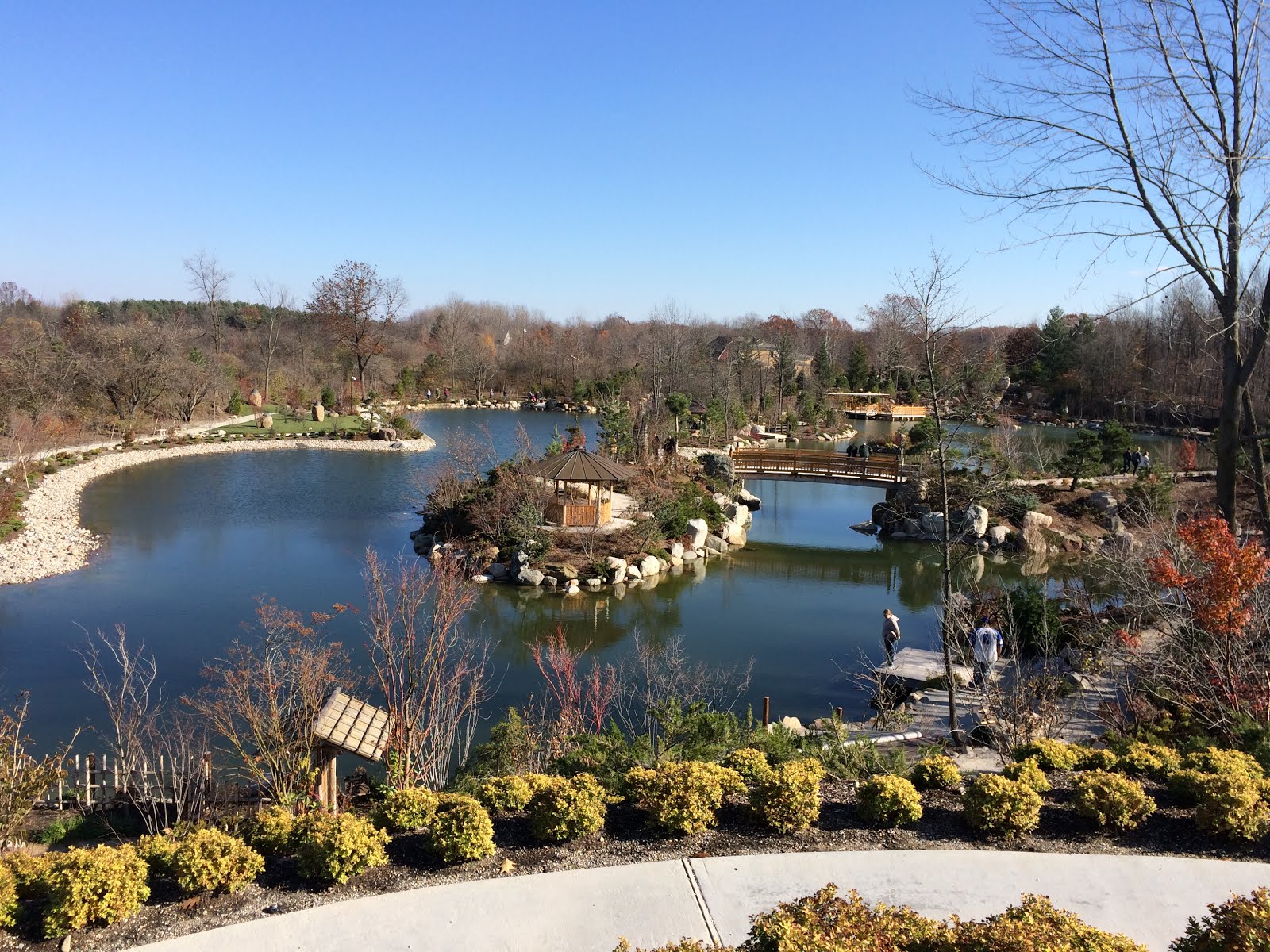
As I drove home on Sunday afternoon, I wasn't ready for the weekend to be over so I stopped off at the Meijer Gardens to see their new Japanese garden. It was relatively peaceful and I could see how much effort the designers put into making it serene and contemplative. Took lots of pictures, but as I walked around, there were no real epiphanies other than I should come back here when the flowers are in full bloom.


Normally, I'd be looking forward to the Waterloo Festival for Animated Cinema as my last hurrah before the insanity of the holiday season--Thanksgiving, Christmas, and my and several of my relatives' birthdays. But with WFAC still being unofficially on permanent hiatus, the festival season was officially over and I was left walking that path away from 2015 and towards 2016 with all it's hopes and challenges.

 |
| ASIFA Retreat at the Wealthy Theater |
 |
| The official ASIFA Retreat book (and lotsa cards) |
 |
| The full spread including the annual ASIFA cake! |
 |
| Animators realizing that the food is real and not 3d modeled! |
 |
| Jim opening the retreat with a reading from the "Book of McCay" |
 |
| Another reading from the "Book of McCay" |
The first night over, we broke for the evening. And like last year, Deanna saved me on gas money and driving time by graciously providing a guest bedroom.
 |
| Mints on the pillow and a copy of "Animatoon Magazine"... only at 'Casa de Deanna'. :) |
The next day, we spent the better part of the morning and part of the afternoon holding a hands-on traditional under-the-camera workshop at the Grand Rapids Community Media Center.
 |
| Our International Animation Day Coordinator Brad Yarhouse working with a student on a sand animation. |
 |
| Visitors from Lansing trying their hands at some stop-motion animation |
 |
| Brad introducing this year's International Animation Day Program |
 |
| Deanna's presentation on the her artist residency |
 |
| Jim Middleton recreating and modernizing a live performance of "Gertie." |
 |
| 'Motion Comics and the Future of Comic Books' |
We ended the evening with "Gary Schwartz' European adventures"--a presentation of his work overseas in Eastern Europe where he runs youth animation workshops, most recently in Armenia.
 |
| Gary Schwartz |
 |
| An animation Gary's students put together during his workshop. |
 |
| Making the case for us to make the trip to Eastern Europe |
 |
| Gary returned with many souvenirs, some from the old Soviet Union days. |
As I drove home on Sunday afternoon, I wasn't ready for the weekend to be over so I stopped off at the Meijer Gardens to see their new Japanese garden. It was relatively peaceful and I could see how much effort the designers put into making it serene and contemplative. Took lots of pictures, but as I walked around, there were no real epiphanies other than I should come back here when the flowers are in full bloom.

 |
| Testing out the panoramic setting on my smartphone. click the image for a larger view. |

Subscribe to:
Posts (Atom)